
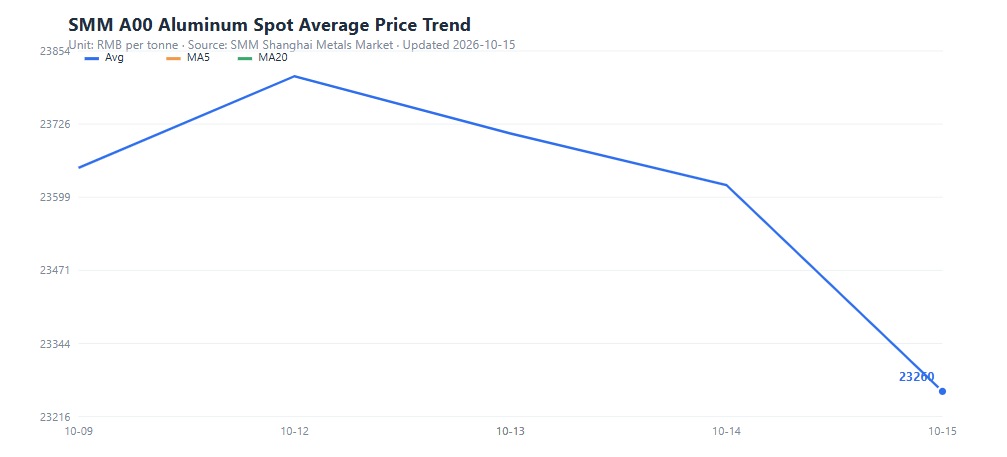
In October 2026, the SMM A00 aluminum spot average traded in a band of RMB 23,260–23,810 per tonne, with a month-to-date average near RMB 23,610/t (about USD 3.30/kg at an indicative RMB/USD 7.15). As of 2026-10-15, the spot stood at RMB 23,260/t (about USD 3.25/kg), -3.2% versus 7 days earlier. Over the past seven days the price moved about 3.2%, so the near-term read is range-bound-to-soft rather than trending hard in either direction. For international buyers, the ex-works price of Aluminum Profile depends on more than the base metal. The main cost drivers are:
All figures below are indicative, market-dependent, ex-works China, and exclude freight, packing, and import duties. They are derived from the SMM A00 anchor plus typical conversion and grade premiums, and must be confirmed against a formal GNEE quotation. Trend (▲ / ▼ / —) reflects the aluminum base direction versus the start of October 2026.
| Product | Size (mm) | Grade | Surface | Price (USD/kg) | Price (USD/t) | Trend | Remark |
|---|---|---|---|---|---|---|---|
| Profile (mill) | standard sections | 6063-T5 | Mill | 3.5–4.2 | 3,500–4,200 | ▲ | indicative, ex-works |
| Profile (mill) | standard sections | 6061-T6 | Mill | 3.8–4.6 | 3,800–4,600 | ▲ | +3–6% vs 6063 (structural) |
| Profile (anodized) | standard sections | 6063-T5 | Anodized | 3.8–4.5 | 3,800–4,500 | ▲ | surface +0.3–0.6 USD/kg |
| Profile (powder) | standard sections | 6061-T6 | Powder | 4.0–4.8 | 4,000–4,800 | ▲ | coating extra |
| Profile (per drawing) | custom | 6005-T5 | Mill | 3.9–4.7 | 3,900–4,700 | ▲ | die amortization |
| Profile (anodized) | standard sections | 6061-T6 | Anodized | 4.1–4.9 | 4,100–4,900 | ▲ | structural + anodized |
Update month: October 2026 (data as of 2026-10-15, SMM A00). Profile prices reflect extrusion and surface options; indicative, ex-works, revised monthly with the SMM A00 anchor.
6061-T6 carries a +3–6% cost premium over 6063-T5 in like-for-like supply, and the gap is metallurgical rather than cosmetic. The measured properties below are the evidence, not a description:
| Metric | 6063-T5 | 6061-T6 | Difference (B vs A) |
|---|---|---|---|
| Tensile strength (MPa) | 175–186 | 310 | +72% |
| Yield strength, 0.2% offset (MPa) | 130–145 | 276 | +101% |
| Elongation (%) | ≥8 | 12 | +4 pp |
| Density (g/cm3) | 2.70 | 2.70 | no material difference |
| Thermal conductivity (W/m·K) | 209 | 167 | -20% |
| Electrical conductivity (% IACS) | 53% IACS | 43% IACS | -10 pp |
| Relative cost, ex-works | baseline | typically +3–6% | +3–6% |
Bottom line: 6063-T5 covers general fabrication at the lower cost per kg, and the table above shows exactly where it stops. Step up to 6061-T6 when the design load calls for its tensile and yield values — and accept the conductivity figures listed in the same row.
Cost trade-off: specify 6063-T5 unless the structure genuinely demands 6061-T6; reserve 6005-T5 for finish-critical architectural work. Avoid over-specifying temper or surface treatment you do not need — a standard mill-finish 6063-T5 is the cheapest defensible option.
Typical supply specifications:
| Item | Value |
|---|---|
| Temper | T5 / T6 (per grade) |
| Standard | ASTM B221 / EN 755 / GB/T 6892 |
| Size | standard sections or per drawing |
| Surface | Mill, anodized, powder-coated |
| MOQ | Flexible, small orders negotiable |
| Lead time | 15–30 days |
Quick cost check: total material cost = weight (kg) × price per kg. For example, 5,000 kg of 6063-T5 at USD 3.5/kg is about USD 17,500 ex-works, before conversion extras, freight, and duties.
Tell us your grade, size, temper, quantity, and destination, and GNEE returns an indicative ex-works or FOB price within 1–2 working days. MOQ is flexible and standard lead time is 15–30 days. Use the table above as a planning range, then request a firm quote for your specific order.
Disclaimer: prices on this page are indicative and market-dependent; the aluminum base is sourced from SMM Shanghai Metals Market and is subject to SMM’s official release. Confirm all figures against a formal GNEE quotation before procurement.