
Aluminum perforated sheet is a flat aluminum product manufactured with regularly or specially arranged holes across part or all of its surface. The holes can be round, square, slotted, hexagonal or customized according to the design requirements.
By adjusting the hole diameter, pitch, pattern, sheet thickness and open area, manufacturers can produce perforated aluminum sheets for different requirements involving ventilation, screening, light transmission, decorative appearance and equipment protection.
Aluminum is commonly selected for perforated metal products because of its relatively low density, corrosion resistance and formability. However, the performance of a finished perforated sheet depends not only on the aluminum alloy but also on the perforation layout, remaining material between holes, panel dimensions and installation conditions.
This guide explains the main types, material options, technical specifications, manufacturing considerations and applications of aluminum perforated sheets.
Aluminum perforated sheet is an aluminum sheet with holes formed through a mechanical or other suitable perforation process. The holes may follow a regular geometric pattern or a custom layout specified by the customer.
The main design parameters include:
These parameters work together to determine the appearance, airflow characteristics, screening behavior and mechanical properties of the finished panel.
Aluminum perforated sheets are commonly classified by their hole shapes and arrangements. The appropriate pattern depends on the intended function, visual requirements and manufacturing constraints.
Round hole perforated aluminum sheet has circular openings arranged in regular rows or staggered patterns.
Common arrangements include:
Round holes are widely used in ventilation panels, architectural screens, equipment guards and industrial screening components.
The hole diameter, pitch and arrangement determine the open area and the amount of material remaining between adjacent openings.
Square hole perforated aluminum sheet features square openings arranged in a regular grid or customized layout.
The square geometry provides a different visual appearance from round holes and may be selected for screening, ventilation and decorative applications.
When specifying square perforations, buyers should confirm the opening width, pitch, orientation and minimum material bridge between adjacent holes.
Slotted perforated aluminum sheet contains elongated openings. Slots may be arranged horizontally, vertically or at specified angles.
The main parameters include:
Slotted patterns can be useful when a project requires directional openings or a particular visual effect.
Hexagonal perforated aluminum sheet features six-sided openings arranged in a repeated pattern.
It is commonly considered for decorative panels, ventilation covers and selected screening applications.
The hexagonal opening dimensions, pitch and layout should be defined clearly in the technical drawing.
Some projects require triangular, diamond-shaped, cross-shaped, irregular or specially designed openings.
Custom perforation is generally specified through a drawing, sample or detailed pattern description.
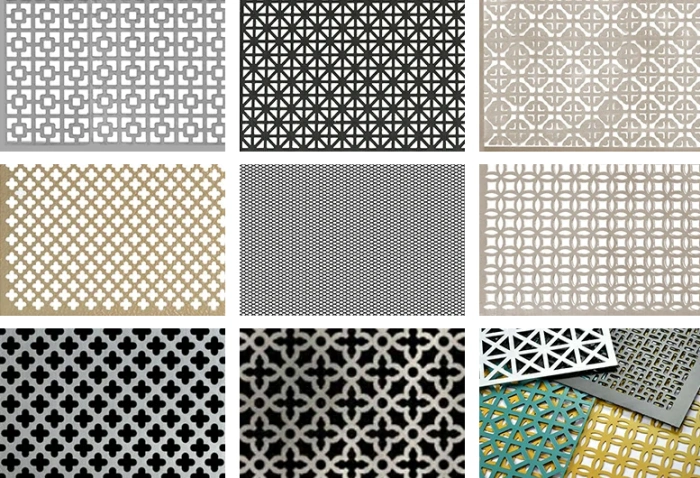
The aluminum alloy should be selected according to the required formability, strength, corrosion resistance, surface finish and service environment.
Common alloy families considered for perforated aluminum sheets include the 1000, 3000, 5000 and 6000 series.
| Aluminum Alloy | General Characteristics | Typical Selection Considerations |
|---|---|---|
| 1050 / 1060 | High aluminum content, good formability and electrical and thermal conductivity | General-purpose panels and applications requiring good formability |
| 1100 | Commercially pure aluminum with good workability | General sheet fabrication and decorative applications |
| 3003 | Aluminum-manganese alloy with good formability and corrosion resistance | General architectural and industrial panels |
| 5052 | Aluminum-magnesium alloy with good corrosion resistance and higher strength than commercially pure aluminum grades | Outdoor panels and applications with more demanding mechanical requirements |
| 5083 | Aluminum-magnesium alloy with high strength and good corrosion resistance | Selected heavy-duty and marine-related applications, subject to product standard and temper requirements |
| 6061 | Heat-treatable aluminum-magnesium-silicon alloy | Fabricated components and applications requiring higher strength |
The table provides general material-selection guidance rather than a guarantee that every alloy is available in every perforation thickness or temper.
The suitability of an alloy also depends on the forming process. A material that performs well as a solid sheet may behave differently after extensive perforation, bending or other fabrication.
Hole geometry is one of the most important considerations when designing aluminum perforated sheets.
Hole diameter is the measured diameter of a circular opening.
A larger hole generally increases the opening area when the pitch remains unchanged. However, it also reduces the amount of material remaining between adjacent holes.
The selected hole diameter should therefore consider the intended screening or ventilation function, the sheet thickness and the mechanical requirements of the finished panel.
Pitch refers to the distance between the centers of adjacent holes.
For regular circular-hole patterns, pitch is usually specified in the horizontal and vertical directions or as the nearest-neighbor center distance, depending on the arrangement.
The distinction matters because a staggered pattern and a straight pattern use different geometric relationships.
Open area is the percentage of the perforated surface occupied by holes.
It can be calculated as:
O4pen Area (%) = Total Area of Openings ÷ Perforated Area × 100
For a regular circular-hole pattern, theoretical open area can be calculated using the hole diameter and pitch.
For a 60-degree staggered pattern:
[
OA = 90.69 \times \left(\frac{D}{P}\right)^2
]
For a 90-degree straight pattern with equal horizontal and vertical pitch:
[
OA = 78.54 \times \left(\frac{D}{P}\right)^2
]
Where:
These formulas apply to ideal, repeating circular-hole patterns. Actual sheet open area may differ when the panel includes unperforated edges, special boundary holes, non-uniform spacing or other solid sections.
Open area influences several functional characteristics:
| Requirement | Relevant Design Considerations |
|---|---|
| Ventilation | Open area, hole size and airflow resistance |
| Light transmission | Opening size, pattern and panel arrangement |
| Screening | Aperture size and opening distribution |
| Decorative appearance | Hole density, pattern and viewing distance |
| Equipment protection | Opening size, material thickness and mechanical design |
| Acoustic applications | Perforation geometry, backing material, cavity and complete acoustic assembly |
A higher open area does not automatically mean better overall performance. For example, a ventilation panel must also be evaluated for pressure drop, airflow direction and installation conditions.
Similarly, acoustic performance cannot be determined from open area alone.
| Item | Specification |
| Alloy Grades | 1100 / 3003 / 5052 |
| Thickness | 0.5 mm – 10.0 mm |
| Standard Width | 1000 mm – 2000 mm |
| Standard Length | 2000 mm – 6000 mm |
| Hole Diameter | 0.5 mm – 100.0 mm |
| Hole Pattern | Round, Square, Slotted, Hexagonal, Custom |
| Open Area Rate | 5% – 80% |
| Production Standard | ASTM B209 / EN 485 |
The manufacturing process depends on the material thickness, hole geometry, production volume and dimensional requirements.
Mechanical punching uses punches and dies to form openings in the aluminum sheet.
Depending on the equipment and tooling, manufacturers may produce repeated standard patterns or customized perforation layouts.
The tooling design, punch clearance, material condition and perforation sequence can affect hole quality and dimensional consistency.
Laser cutting can be used to produce customized openings and complex contours.
It is particularly relevant when a design requires non-standard shapes or when the panel outline must be cut according to a drawing.
However, laser cutting and mechanical punching have different production characteristics. The preferred process depends on the material thickness, hole dimensions, quantity, cost and required edge quality.
Perforation may leave burrs or sharp edges depending on the process and tooling condition.
Deburring may be required to improve handling safety and edge quality.
Additional surface treatments may include:
The suitability of a finish depends on the alloy, surface condition, intended environment and project specifications.
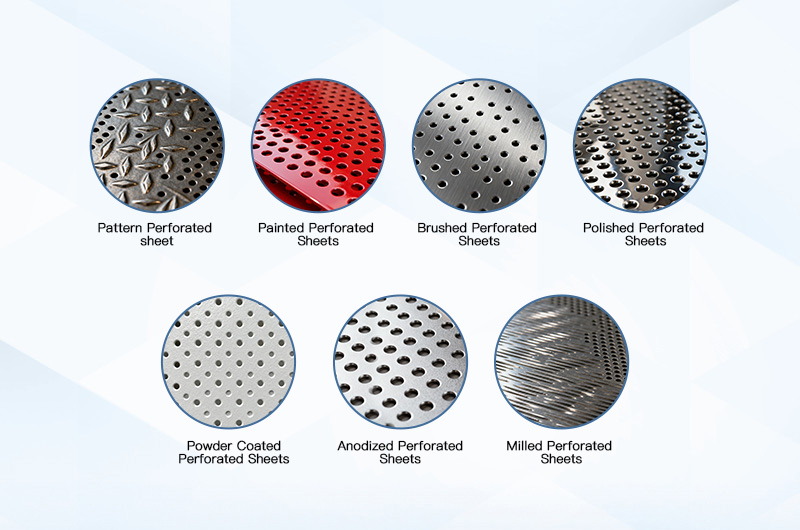
Aluminum perforated sheets are used in architectural, industrial, transportation and equipment-related applications.
Perforated aluminum panels are used as decorative screens, facade elements and sun-shading components.
The hole pattern and open area influence visual transparency, daylight transmission and shading characteristics.
For exterior applications, buyers should also consider alloy selection, coating durability, panel dimensions, wind loading and the complete support system.
Perforated aluminum sheets can be used in suspended ceilings, interior partitions and decorative wall panels.
The design may combine a specific hole pattern with anodizing, powder coating or other surface finishes.
For acoustic ceiling systems, the performance depends on the complete assembly, including the perforated face sheet, backing material, air cavity and installation conditions.
Perforated aluminum sheets are used in ventilation grilles, air intake covers, equipment enclosures and protective panels.
Hole diameter and open area should be selected according to the required airflow and equipment protection requirements.
Perforated sheets can serve as screening or supporting components in industrial equipment.
The opening dimensions should be selected according to the particle size, material flow and process requirements.
Perforated aluminum sheet should not automatically be treated as a precision filter medium. Applications requiring defined filtration efficiency or fine particle separation need specific performance testing and design verification.
Perforated aluminum panels may be used in selected transportation and infrastructure applications, including protective covers, decorative screens and ventilation components.
The alloy, thickness, corrosion protection and mechanical design should be evaluated according to the actual service environment.
Selecting a suitable perforated sheet requires more than choosing a hole pattern.
Identify whether the sheet will be used for ventilation, screening, decoration, equipment protection or another purpose.
The application determines which technical properties require the most attention.
Choose the material according to strength, formability, corrosion resistance, surface finish and applicable standards.
For demanding environments, verify the suitability of the alloy and temper rather than relying only on a general material description.
Specify the base sheet thickness, width and length.
For large panels, also consider handling, transportation, support spacing and installation requirements.
Confirm the hole shape, diameter, pitch and arrangement.
For circular holes, indicate whether the layout is 60-degree staggered, 90-degree straight or another specified pattern.
Provide the required open area when it is known.
Also specify any unperforated edges, mounting zones or solid sections required for fastening and fabrication.
Indicate whether the finished sheet requires cutting, bending, deburring, leveling, welding or surface treatment.
These requirements should be reviewed together because additional fabrication can affect the final dimensions and appearance.
Specify the required inspection items, material certificates, dimensional records and third-party testing requirements before production.
Aluminum perforated sheets are used in architectural screens, ventilation panels, decorative ceilings, equipment covers, industrial screening and selected filtration-related components. The application depends on the hole geometry, material, thickness and required performance.
A straight pattern arranges holes in aligned rows and columns. A staggered pattern offsets adjacent rows. For the same circular-hole diameter and nearest-neighbor pitch, a 60-degree staggered pattern generally provides a higher theoretical open area than a square straight pattern.
Open area is calculated by dividing the total area of the openings by the relevant perforated surface area and multiplying by 100%. For regular circular-hole patterns, the hole diameter and pitch can be used to calculate the theoretical open area.
Commonly considered alloys include 1050, 1060, 1100, 3003, 5052 and 6061. The appropriate choice depends on the required strength, formability, corrosion resistance, temper and application.
Custom perforated sheets can be specified by drawings or samples, subject to the manufacturer’s equipment, tooling and processing capabilities. The drawing should identify material, thickness, panel dimensions, hole geometry, pitch, arrangement and edge margins.
Yes. Perforation reduces the amount of continuous material and changes the stiffness and load-bearing behavior of the sheet. The final mechanical performance depends on the alloy, temper, thickness, hole dimensions, pitch, pattern, panel size and support conditions.
Anodizing and powder coating may be available depending on the alloy, product dimensions, surface requirements and processing capabilities. The required finish should be confirmed before production.
It can be used as the perforated facing component of an acoustic assembly. However, acoustic performance depends on the hole geometry, open area, backing material, cavity depth and complete system design. A perforated sheet alone does not establish a specific sound absorption rating.
Aluminum perforated sheet is a versatile material for applications requiring controlled openings, reduced material coverage, ventilation, screening or decorative effects.
Selecting the right product requires a coordinated review of aluminum alloy, temper, sheet thickness, hole geometry, pitch, open area, edge margins and additional processing requirements.
For project-specific orders, providing a technical drawing or a complete set of product parameters is the most effective way to confirm manufacturability and obtain an accurate quotation.